
The Cheapest Hour Is the Most Expensive Way to Build

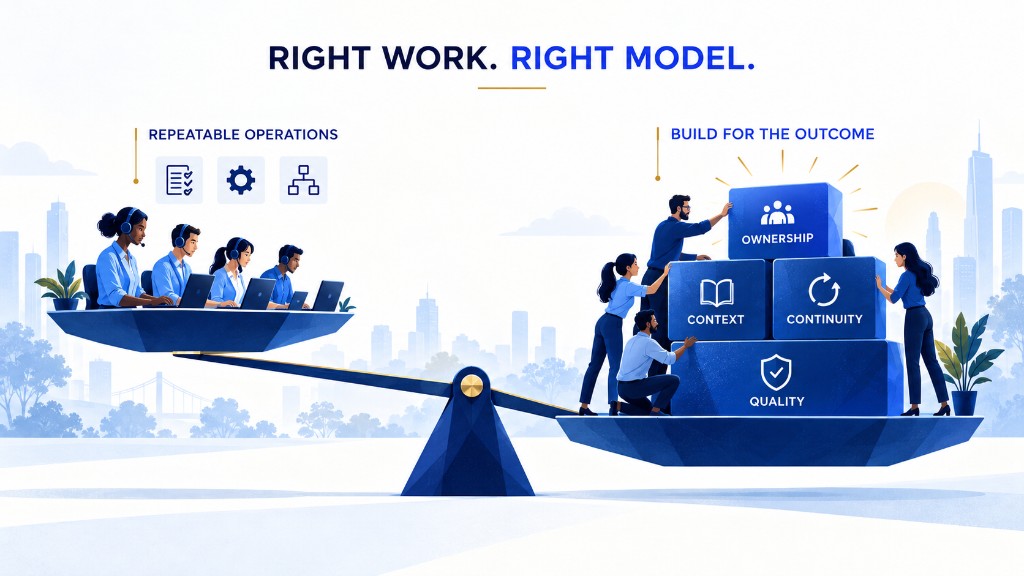
There is a good reason business process outsourcing became one of the largest industries on earth. When a company needs a defined, repeatable process run reliably and cheaply, the BPO model is genuinely the right answer. Customer support, claims processing, payroll, tier-one helpdesk, maintaining an ERP system that already exists: this is the work it was made for. It takes a known process off your plate at a fraction of the domestic cost, and it does that at a scale that is hard to comprehend.
So before the argument, the honest part: for the right job, BPO isn't just acceptable. It's the correct call. This piece is about what happens when founders reach for the wrong one.
The scale is real, and it's not slowing down
The global BPO market is worth somewhere north of $300 billion and climbing toward half a trillion by the early 2030s, growing at roughly 8 to 10 percent a year. India delivers around 55 percent of the world's outsourcing and exported $194 billion in IT-BPM services in a single year; the Philippines has built a $40-billion-plus industry employing nearly two million people and contributing close to 9 percent of its GDP. North America, led by the US, is the largest buyer of all this: a $110-billion-plus market of companies sending work abroad, pushed by relentless labor-cost pressure and chronic shortages in specialized roles, with Asia-Pacific growing faster than any region on earth.
This is not a fad, and nothing here is an argument that BPO is going away. It is enormous, it is durable, and for the work it was built to do, it is only getting better. The question isn't whether BPO works. It's what it works for.
Most outsourced work is bought on the cheapest possible hour
Most outsourced labor is bought on one variable: price per hour. That's the product. Buyers run procurement processes to drive the rate down, providers compete on rate because that is what buyers reward, and the whole arrangement is tuned to deliver acceptable output at the lowest possible cost. For commoditized, well-defined work, that's exactly what you want. You don't need brilliance to reset a password. You need reliability at a price.
But when the buyer optimizes for price, quality becomes whatever the contract says it is. A contract written around cost holds quality to the floor it specifies: "acceptable," not "exceptional." The provider delivers what was bought. Buy the lowest rate, and the lowest rate is what shows up in the work.
Buying on price gets you cheap, not excellent. That single fact is the root of everything that makes it the wrong way to buy for a company trying to win on the strength of what it builds.
Work bought at the floor doesn't stay
Here's what the low rate actually buys, and it's the part the quote never shows you. The clearest evidence comes from the highest-volume corner of outsourcing, the contact center: average annual attrition sits at 40 to 45 percent, offshore voice floors run 45 to 60 percent, and Indian call centers have reported figures as high as 55 percent with first-year attrition of 70 percent. Average agent tenure is roughly 14 months.
Engineering isn't a call floor, but the mechanism travels. When the buyer rewards the lowest rate, margins sit at the floor, wages follow, and anyone paid at the floor leaves for a fractionally better offer. Operators who invest in training and pay above the minimum are working against the terms their buyers set. You cannot buy loyalty at the lowest bid.
Now run that through the things that actually make a team valuable to you. Culture takes time to form, and turnover resets it. Training compounds only if people stay. The context someone builds about your product, your codebase, your customers leaves when they do and takes the institutional memory with it. Buy on rate, and you are not building a team. You are buying a seat whose occupant keeps changing.
The distance and fragmentation problem, again
Everything that makes a scattered, assembled-from-anywhere workforce hard to build applies here too. A team bought on rate is sourced wherever the rate is lowest, spread across locations and time zones, and connected to you through tickets, handoffs, and status reports. The friction isn't about any nationality. It's about fragmentation and distance, which the research on distributed teams measures plainly: co-located teams succeed far more often than scattered ones, and misunderstandings that a shared desk resolves in seconds persist for days across a remote handoff. Structure the relationship as the cheapest acceptable output delivered at arm's length, and the distance is part of what you bought.
What a fast-growing company actually needs
Now picture the company this is wrong for. A funded startup, a premium engineering agency. A team whose entire reason to exist is to build something better than the competition, faster than the competition, and to keep winning on that basis. What does that company need from the people who build its product?
It needs senior, outcome-oriented engineers who own results rather than tickets. It needs people who stay long enough to develop deep knowledge of the product and compound it. It needs a real team with a shared culture, not a rotating roster held together by a contract. It needs the top of the market, the people who help you win, not whoever clears the quality floor at the lowest rate. None of those things are cheap or interchangeable, which is exactly why they are hard to get when engineering is bought as interchangeable labor.
This is the mismatch in one line: buying on rate optimizes for the lowest cost of acceptable output. A company building to win needs the highest quality of outcome. Those are different objectives, and no amount of good management makes a cost-minimizing purchase produce a quality-maximizing result. You can't buy the top of the market at the bottom of the price.
Use the right tool for the right job
None of this is a case against BPO. It's a case against buying your product the way you'd buy a process. If you need a call center, an ERP kept running, enterprise admin, tier-one support, or any well-defined process handled reliably at low cost, use a BPO and don't overthink it. It's the correct, proven choice, and the industry's scale is proof it delivers.
But if the work is your product, the math changes. If you need senior engineers who own outcomes, who stay, and who form a real team that gets better at your specific problem every quarter, then the cheapest hour is the most expensive way to build, because you pay for it twice: once in the rate, and again in everything the rate quietly leaves out. The turnover, the reset culture, the lost context, the quality held to a floor instead of pushed toward a ceiling. That bill comes due slowly, and by the time you see it, you've lost the months a competitor spent building a team that stayed.
A senior, cohesive, co-located team built to stay is the entire reason Abet exists, but the principle holds however you build it. The founders who win the next decade won't be the ones who found the lowest rate. They'll be the ones who understood that when the work is the product, quality was never the place to save money.
Share this article